
Whole Life Insurance Cash Flow Strategy: 2026 Guide

Updated: Jun 27

COMPLIANCE NOTE: For educational purposes only. Not financial, tax, or legal advice.
A whole life insurance cash flow strategy is the practice of using the cash value inside a permanent life insurance policy to create tax-efficient liquidity, fund investments, and build long-term wealth without surrendering coverage. The life insurance market is valued at approximately $14 trillion, yet nearly 90% of policies never pay a claim. That figure points to a massive pool of untapped cash value sitting idle inside policies that owners never learned to use. The Infinite Banker exists specifically to help entrepreneurs, real estate investors, and high-income earners put that capital to work through properly structured whole life policies.
How does a whole life insurance cash flow strategy actually work?
The engine of this strategy is cash value, the living benefit inside a permanent policy that grows over time and can be accessed while you are still alive. Unlike term insurance, which expires with no residual asset, whole life policies last indefinitely, creating a permanent financial tool that compounds across decades. The industry term for this approach is “Infinite Banking,” a concept built on using dividend-paying whole life insurance as a personal banking system. The cash flow strategy is the practical application of that concept, directing policy cash value toward real financial needs rather than letting it sit unused.

How does cash value accumulate in whole life insurance policies?
Cash value builds because a portion of every premium you pay goes into a separate account within the policy, distinct from the cost of insurance. Whole life policies guarantee level premiums, a fixed death benefit, and cash value growth at a predictable interest rate. That predictability is what separates whole life from other permanent products.
Participating whole life policies add another layer of growth through dividends. Dividends depend on insurer performance and are not guaranteed, but mutual insurance companies have paid them consistently for over a century. When dividends are applied to purchase paid-up additions, they accelerate cash value growth faster than the base policy alone.
Cash value growth is tax-deferred, meaning you owe no income tax on the internal gains each year. For business owners and high earners who have already maxed out 401(k) and IRA contributions, this creates a meaningful third bucket for wealth accumulation. The growth compounds quietly in the background while the death benefit remains intact.
Key mechanics of cash value accumulation include:
Base premium allocation: A fixed portion of each premium funds the cash value account after covering the cost of insurance.
Guaranteed interest crediting: The insurer credits a minimum interest rate to cash value each year, regardless of market conditions.
Paid-up additions (PUAs): Optional riders that direct extra premium dollars into additional paid-up insurance, accelerating cash value growth significantly.
Dividend reinvestment: In participating policies, dividends applied as PUAs compound the cash value at a rate above the guaranteed floor.
Tax-deferred compounding: No annual tax drag on internal growth, which meaningfully improves long-term accumulation compared to taxable accounts.
Pro Tip: Request an in-force illustration from your insurer at least once a year. It shows your current cash value, projected growth, and dividend history, giving you the data you need to make informed decisions about loans or withdrawals.
What are the methods to leverage cash value for generating cash flow?
Policy loans are the primary tool for accessing cash value without triggering a taxable event. When you borrow against your policy, you are not withdrawing from the cash value directly. The insurer lends from its general fund, using your cash value as collateral. The loan does not appear on a credit report, requires no approval process, and carries no mandatory repayment schedule.
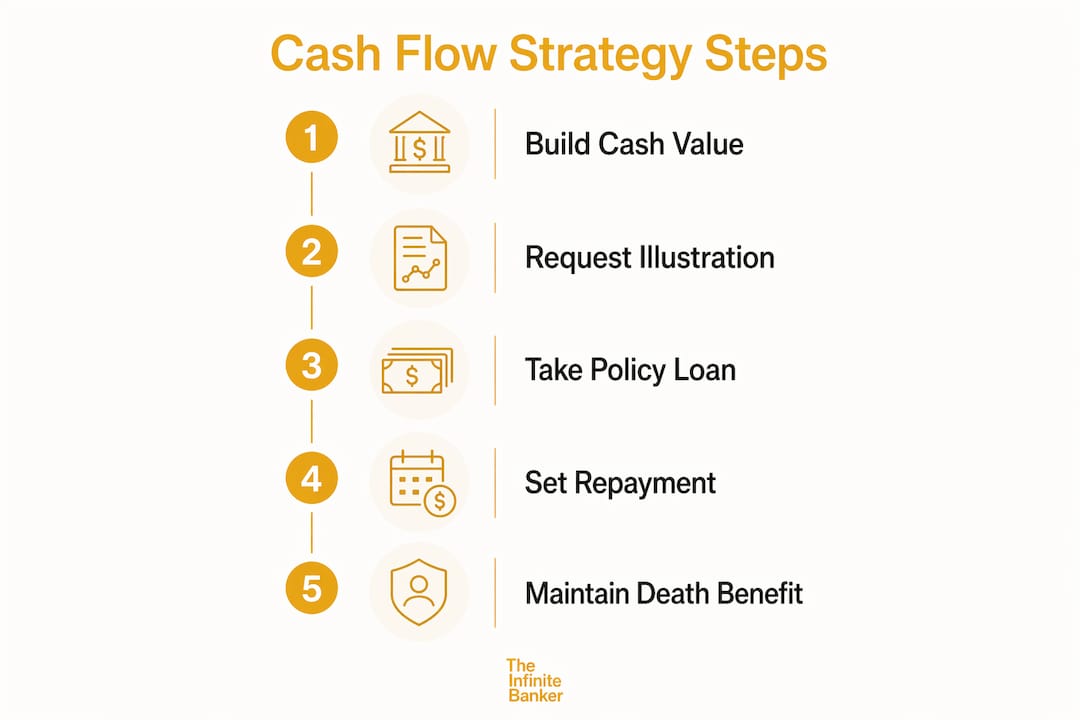
The tax treatment is a critical advantage. Because policy loans are loans and not distributions, they do not count as taxable income. A real estate investor who needs $80,000 for a down payment can borrow against a policy, deploy the capital, and repay the loan on their own timeline. The Infinite Banker covers this mechanic in detail in its guide on policy loan mechanics.
Withdrawals work differently. A withdrawal permanently reduces both the cash value and the death benefit. Loans, by contrast, leave the full cash value in place as collateral, so dividends and interest continue to accrue on the entire balance. That distinction matters enormously for long-term policy health.
The four primary methods for generating cash flow from a whole life policy are:
Policy loans for capital deployment: Borrow against cash value to fund a business expense, real estate purchase, or investment opportunity. Repay on your schedule to restore the death benefit.
Partial withdrawals for one-time needs: Access cash value directly for a specific expense. This reduces the policy permanently, so use it selectively.
Automatic premium loans (APLs): If you miss a premium payment, the insurer automatically uses cash value to cover it, preventing a lapse. This is a safety net, not a primary strategy.
1035 exchanges: Transfer cash value to a different policy without triggering taxes, useful if your original policy is not designed for cash flow efficiency.
Loan interest accrues at roughly 3–5% annually and compounds over time. Leaving a loan unpaid for years can erode the death benefit and reduce dividend participation. Repayment discipline is not optional if you want the strategy to function across decades.
Pro Tip: Treat every policy loan like a business loan. Set a repayment schedule before you borrow, not after. The policy does not enforce repayment, but your long-term results depend on it.
What prerequisites and financial mindset support a successful strategy?
The death benefit is the primary contractual obligation of the insurer, and maintaining it is the foundation of the entire cash flow strategy. If the policy lapses because premiums stop, the cash value disappears and the death benefit ends. Every other benefit depends on keeping the policy in force.
Whole life insurance is not a short-term tool. Cash value builds slowly in the early years because a larger share of the premium covers the cost of insurance. The funding lag, the period before cash value reaches meaningful levels, typically spans the first three to five years. Buyers who expect immediate liquidity are often disappointed. The correct mindset treats the policy as a decades-long financial asset, not a savings account with a faster return.
Policy design determines how quickly cash value becomes usable. A policy built for cash flow uses a blended structure: a smaller base death benefit paired with a large paid-up additions rider. This design front-loads cash value growth. The Infinite Banker’s guide on policy design elements explains how base policies, blended designs, and strategic riders interact to maximize early cash value.
Prerequisites for a successful implementation include:
Premium consistency: Missing premiums forces the policy to use cash value for coverage costs, slowing accumulation and risking lapse.
Participating policy selection: Only dividend-paying whole life policies offer the compounding dividend layer that makes the strategy most effective.
Appropriate policy design: A policy designed for death benefit protection accumulates cash value more slowly than one designed for cash flow. Work with an advisor who understands the distinction.
Integration with a broader financial plan: The strategy works best alongside retirement accounts, real estate holdings, or business cash flow planning, not as a standalone product.
Universal life policies offer premium flexibility but can require large lump-sum payments to stay solvent if interest rates shift. Whole life’s fixed premiums and guaranteed growth make it the more predictable tool for cash flow planning over a lifetime.
What common mistakes undermine a whole life cash flow strategy?
The most damaging mistake is treating cash value as free money. Unpaid policy loans reduce the death benefit dollar for dollar and can reduce dividend participation. A $50,000 loan left unpaid for ten years at 5% compounding interest becomes a much larger liability against the policy than most owners anticipate.
Misunderstanding loan interest is the second most common error. Borrowers sometimes assume the interest is negligible because there is no monthly bill. The insurer simply adds accrued interest to the loan balance. Over time, a growing loan balance can consume the entire cash value and cause the policy to lapse, triggering a taxable event on any gains.
Common pitfalls to avoid:
Overleveraging cash value: Borrowing close to the full cash value leaves no buffer. If the policy value dips, the insurer may require immediate repayment or face a lapse.
Ignoring annual policy statements: The statement shows your loan balance, accrued interest, current cash value, and death benefit. Reviewing it annually is the minimum standard.
Choosing the wrong policy structure: A policy designed for maximum death benefit accumulates cash value slowly. Verify the design before purchase.
Stopping premiums prematurely: Lapsing a policy in the early years often means losing more than you put in, with no death benefit and a potential tax bill on gains.
Pro Tip: Time large policy loans to coincide with periods when you have a clear repayment source, such as a property sale, business revenue cycle, or tax refund. Borrowing without a repayment plan is the fastest way to damage a policy that took years to build.
Working with an advisor who specializes in cash value strategies, not just life insurance sales, is the most reliable way to avoid these errors. The Infinite Banker’s comparison of HELOC vs policy loans illustrates how the two liquidity tools differ in access, timing, and long-term cost.
Key Takeaways
A whole life insurance cash flow strategy works only when the policy is properly designed, premiums are paid consistently, and policy loans are managed with the same discipline as any business debt.
Point | Details |
Cash value grows tax-deferred | Internal gains compound without annual tax drag, improving long-term accumulation. |
Policy loans are not taxable events | Borrowing against cash value does not trigger income tax, unlike most asset withdrawals. |
Loan interest compounds silently | Accruing interest at 3–5% annually can erode the death benefit if loans go unmanaged. |
Policy design determines usability | A blended base policy with paid-up additions riders builds cash value faster for cash flow use. |
Premium consistency is non-negotiable | Missing premiums slows accumulation and risks lapsing the policy, ending all benefits. |
What I have learned from watching clients use this strategy
Most people who come to this strategy have already read the theory. They understand policy loans, tax deferral, and dividends in the abstract. What trips them up is the gap between understanding the concept and actually managing a policy like a financial instrument.
The clients who get the most from their policies share one habit: they treat the policy loan repayment schedule the same way they treat a mortgage payment. It is not optional, and it is not something they revisit when they feel like it. They set a repayment amount, automate it where possible, and review the policy statement every year without exception.
The second thing I have observed is that most people underestimate how much the policy design matters. A policy sold primarily as life insurance protection will accumulate cash value slowly. A policy built for Infinite Banking, with a large paid-up additions rider and a smaller base death benefit, can have meaningful cash value within two to three years. The difference in design is the difference between a tool that works and one that frustrates.
The third pattern is impatience. The funding lag is real. The first few years feel slow because they are slow. But the compounding that happens in years ten through thirty is where the strategy pays off. Clients who stay the course and keep premiums funded through the early years consistently report that the policy becomes one of their most flexible financial assets over time. The ones who quit early rarely have anything to show for it.
— Jib Hunt
How The Infinite Banker supports your cash flow strategy
The Infinite Banker is built for entrepreneurs, real estate investors, and high-income earners who want to implement whole life insurance strategies with precision, not guesswork.

The platform publishes in-depth guides on policy design, loan mechanics, and real-world applications across business and real estate. Whether you are evaluating your first policy or managing an existing one, The Infinite Banker provides the frameworks and analysis you need to make informed decisions. The content covers everything from how policies are structured to how cash value compares to traditional savings tools, written by practitioners who use these strategies themselves. Start with the guides, apply the principles, and build a policy that works as hard as you do.
FAQ
What is a whole life insurance cash flow strategy?
A whole life insurance cash flow strategy uses the cash value inside a permanent life insurance policy to generate tax-efficient liquidity through policy loans and withdrawals. The goal is to access capital without triggering taxable events while maintaining lifelong death benefit coverage.
Are policy loans from whole life insurance taxable?
Policy loans are not taxable events because they are loans against the insurer’s general fund, not distributions from the policy. Unpaid loans reduce the death benefit and can trigger taxes if the policy lapses with outstanding loan balances.
How long does it take to build usable cash value?
Cash value builds slowly in the first three to five years due to the funding lag, the period when insurance costs consume a larger share of premiums. A policy designed with paid-up additions riders can reach meaningful cash value levels faster than a standard whole life policy.
What is the difference between a policy loan and a withdrawal?
A policy loan uses cash value as collateral while leaving the full balance in place to continue earning interest and dividends. A withdrawal permanently reduces both the cash value and the death benefit, making loans the preferred method for most cash flow applications.
Can business owners use whole life insurance for cash flow?
Business owners use policy loans to fund operating expenses, equipment purchases, and real estate down payments without bank approval or credit checks. The Infinite Banker’s guide on real estate applications details how investors deploy this strategy in practice.
This post is for educational purposes only and does not constitute financial, tax, or legal advice. Individual circumstances vary. Consult with qualified professionals before making any decisions regarding insurance or capital strategy.
Comments