
Financial Independence Strategy 2026: Your Complete Roadmap


COMPLIANCE NOTE: For educational purposes only. Not financial, tax, or legal advice.
A financial independence strategy is defined as a structured plan to accumulate enough invested assets and passive income to cover your living expenses indefinitely, without requiring active work. The widely accepted standard, known as the 4% rule, targets 25 times your annual expenses as your financial independence number. For 2026, that framework has evolved. Longer lifespans, updated IRS contribution limits, and shifting withdrawal rate research have changed what a sound financial independence plan looks like. This guide covers the core mechanics: savings rates, account sequencing, withdrawal strategies, and income growth, so you can build a realistic financial independence roadmap for your situation.
What is a financial independence strategy for 2026?
Financial independence, often called financial freedom, means your portfolio and income streams generate enough cash flow to replace your paycheck permanently. The FIRE movement (Financial Independence, Retire Early) popularized this concept, and its core math remains sound: spend less than you earn, invest the difference, and repeat until your assets cover your expenses.
The 4% rule states that withdrawing 4% of your portfolio annually gives a high probability of your money lasting 30 years. That translates to a target of 25 times your annual expenses. However, early retirements lasting 40–50 years require a more conservative withdrawal rate of 3.25%–3.5%, which pushes the target to 28.5–30 times annual expenses. If you plan to retire at 40 rather than 65, the classic 25x number may leave you short.
The 2026 context adds specific numbers worth knowing. The IRS raised contribution limits, giving you more room to save in tax-advantaged accounts than five years ago. Your financial independence goals for 2026 should account for these updated limits and the longer time horizons that early retirement demands.
How does your savings rate affect your timeline to financial independence?
Your savings rate is the single most powerful variable in your financial independence plan. It affects both how fast you accumulate assets and how little you need to cover expenses, since a higher savings rate means lower spending.

The math is stark. A 10% savings rate requires roughly 51 years to reach financial independence. A 50% savings rate cuts that to about 17 years. A 70% savings rate gets you there in approximately 8.5 years. Each jump in savings rate compresses your timeline dramatically, because you are simultaneously building your portfolio faster and reducing the annual expenses your portfolio must cover.
Most people must eliminate high-interest debt and establish emergency funds before attempting savings rates of 50%–70%. Trying to save aggressively while carrying 20% credit card interest is counterproductive. Stabilize your financial foundation first, then push your savings rate.
Here is how savings rate translates to years to financial independence:
Savings rate | Years to financial independence |
10% | ~51 years |
20% | ~37 years |
30% | ~28 years |
50% | ~17 years |
70% | ~8.5 years |
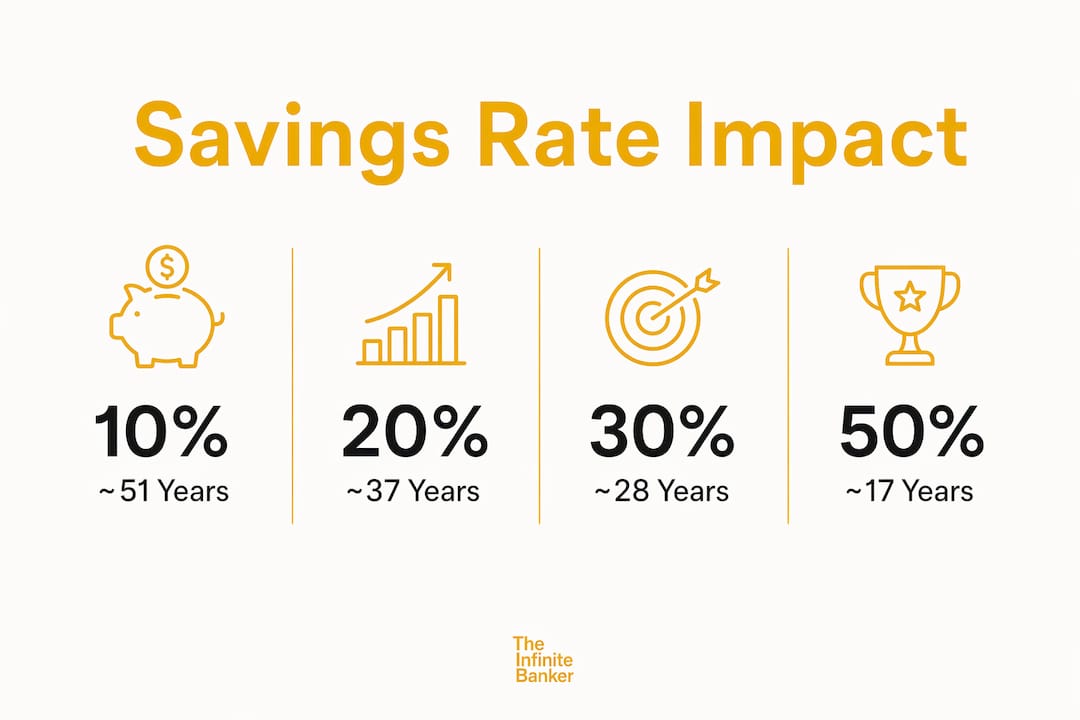
Assumes a 5% real investment return and 4% withdrawal rate.
Pro Tip: Increasing your income accelerates your savings rate faster than cutting expenses alone. Expenses have a floor at zero; income has no ceiling. Focus on both sides of the equation.
The 2026 FIRE movement has shifted noticeably toward income growth over extreme frugality. That shift reflects a practical reality: there is a limit to how much you can cut, but no limit to how much you can earn. Side income, business revenue, and real estate cash flow all raise your savings rate without requiring you to live on rice and beans.
How should you structure your accounts to support financial independence?
Account sequencing is one of the most overlooked parts of a financial independence plan. The order in which you contribute to different accounts determines how much tax drag you carry into retirement.
The recommended contribution sequence for 2026 is:
Capture your full employer 401(k) match first. This is an immediate 50%–100% return on those dollars.
Maximize your Health Savings Account (HSA). The HSA is the only triple-tax-advantaged account available.
Maximize your Roth IRA. Roth accounts grow without tax and withdraw without tax in retirement.
Return to your 401(k) up to the annual limit.
Invest in a taxable brokerage account for flexibility before age 59½.
The 2026 contribution limits are $24,500 for 401(k) contributors under 50, $32,500 for those aged 50–59 or 64 and older, $7,500 for IRAs, and $8,850 for family HSAs. These higher limits mean you can shelter more income from taxes each year than was possible five years ago.
Over-reliance on pre-tax accounts creates a serious problem in retirement. Every dollar you pull from a traditional 401(k) or IRA is taxable income. If your entire portfolio sits in pre-tax accounts, you may face large, unavoidable tax bills in retirement, especially if required minimum distributions push you into higher brackets.
The solution is tax diversification across three buckets:
Pre-tax accounts (traditional 401(k), traditional IRA): taxed on withdrawal
Roth accounts (Roth IRA, Roth 401(k)): taxed on contribution, not on withdrawal
Taxable brokerage accounts: taxed on dividends and capital gains, but accessible at any age
Mixing these three buckets lets you manage your taxable income dynamically across decades. In a low-income year, you draw from pre-tax accounts. In a high-income year, you draw from Roth or taxable accounts. That flexibility can reduce your lifetime tax bill significantly.
Pro Tip: If your employer offers a Roth 401(k) option, consider splitting contributions between traditional and Roth to build both buckets simultaneously.
What withdrawal strategies work for early retirement?
Accessing retirement funds before age 59½ without penalty requires specific strategies. The two most common are the Roth conversion ladder and Substantially Equal Periodic Payments (SEPP), also called 72(t) distributions.
Roth conversion ladder
The Roth conversion ladder works by converting traditional IRA or 401(k) funds to a Roth IRA each year. After five years, those converted funds become accessible without penalty. The critical detail most people miss: you need at least five years of taxable brokerage funds as a cash buffer to cover living expenses while you wait for each conversion to become accessible. Without that bridge, you face a cash flow gap in the early years of retirement.
SEPP / 72(t) distributions
SEPP allows penalty-free withdrawals from retirement accounts before 59½ by committing to a fixed payment schedule calculated by IRS-approved methods. The risk is significant. SEPP withdrawals lock you into fixed payments for five years or until you reach age 59½, whichever is longer. Any deviation from the schedule triggers the 10% early withdrawal penalty retroactively on all prior distributions. That rigidity makes SEPP unsuitable for many early retirees whose expenses fluctuate.
Here is a comparison of the two approaches:
Method | Flexibility | Risk level | Best for |
Roth conversion ladder | High | Low to moderate | Those with 5+ years of bridge funds |
SEPP / 72(t) | Very low | High | Those with stable, predictable expenses |
Pro Tip: Build your taxable brokerage account alongside your retirement accounts from day one. It serves as your bridge account for early retirement and gives you flexibility that tax-advantaged accounts cannot.
The taxable brokerage account is the unsung hero of early retirement planning. It has no contribution limits, no withdrawal restrictions, and no age requirements. For anyone pursuing financial independence before 59½, it functions as the foundation that makes every other strategy work.
How do multiple income streams accelerate financial independence?
Income growth has no ceiling, whereas expense cutting stops at zero. That asymmetry makes income-side strategies the most powerful accelerator in a financial independence plan.
Multiple income streams serve two purposes. First, they raise your savings rate by increasing the gap between income and expenses. Second, they reduce the portfolio size you need, because some expenses may already be covered by passive income before you reach your full financial independence number.
Common income streams that support financial independence goals include:
Real estate rental income: cash flow from residential or commercial properties
Dividend income: distributions from dividend-paying stocks or funds
Business income: revenue from a side business or consulting practice
Digital products or content: royalties, courses, or licensing fees that generate recurring revenue
Managing the tax efficiency of multiple income streams matters as much as generating them. Rental income, for example, may be offset by depreciation deductions. Qualified dividends receive preferential tax rates. Business income may allow contributions to a Solo 401(k) or SEP-IRA, further increasing your tax-advantaged savings capacity.
The Infinite Banker approach uses dividend-paying whole life insurance as a complementary tool within a broader financial independence plan. The cash value in a properly structured whole life policy may serve as a liquid reserve, accessible through policy loans for capital deployment or bridge funding. Dividends on whole life policies are not guaranteed. Policy loans accrue interest and reduce cash value and the death benefit if unpaid. Policies can lapse if not properly funded. These characteristics make whole life insurance a tool for specific situations, not a universal solution.
Key Takeaways
A sound financial independence strategy for 2026 requires the right savings rate, tax-diversified accounts, a realistic withdrawal plan, and multiple income streams working together.
Point | Details |
Savings rate drives timeline | A 50% savings rate reaches financial independence in roughly 17 years; 70% cuts it to 8.5 years. |
Sequence accounts for tax efficiency | Capture employer match, then HSA, Roth IRA, and taxable brokerage to reduce long-term tax drag. |
Early retirement needs a bridge | A Roth conversion ladder requires 5+ years of taxable brokerage funds to cover the waiting period. |
SEPP carries serious risk | 72(t) distributions lock you into fixed payments for 5 years or until 59½, with retroactive penalties for deviations. |
Income growth beats expense cutting | Raising income has no upper limit; expense reduction stops at zero. Prioritize both, but favor income growth. |
The part most financial independence plans get wrong
I have worked with entrepreneurs and investors pursuing financial independence for years as an Authorized IBC Practitioner, and the same mistake appears repeatedly. People build a plan around a single number, hit it, and then discover their tax situation in retirement is far worse than expected.
The three-bucket tax approach is not optional. It is the difference between a portfolio that lasts 40 years and one that gets eroded by taxes in the first decade. Pre-tax accounts feel like the obvious choice when you are accumulating, because the deduction is immediate. But every dollar in a traditional 401(k) is a future tax liability. If you retire early and have no earned income, you have a window to convert those funds to Roth at low tax rates. Most people miss that window because they did not plan for it.
The other pattern I see is treating the taxable brokerage account as an afterthought. People max their 401(k) and IRA, then stop. The taxable account is what gives you flexibility before 59½. Without it, you are either doing a Roth conversion ladder with no bridge funds, or you are locked into SEPP payments that cannot flex with your life.
Infinite banking, when structured correctly, can serve as a liquid reserve layer within a broader plan. The cash value in a whole life policy is accessible without age restrictions, and policy loans do not trigger taxable events. That said, whole life insurance is not a substitute for a diversified investment portfolio. It is a complement, and only for those whose financial foundation is already solid.
Build the foundation first. Get the account sequencing right. Then layer in advanced tools.
— Jib Hunt
How The Infinite Banker fits your financial independence plan
The path to financial independence requires more than a savings target. It requires capital that stays liquid, accessible, and working for you at every stage.
The Infinite Banker helps entrepreneurs, real estate investors, and high-income earners structure whole life insurance policies designed for capital efficiency and long-term flexibility. A properly structured policy may serve as a liquid reserve within your broader financial independence plan, providing access to cash value through policy loans without triggering taxable events. Dividends are not guaranteed, and policy loans accrue interest and reduce cash value and the death benefit if unpaid. To learn whether this approach fits your situation, visit The Infinite Banker or review who this strategy is designed for. Consult a qualified financial professional before making any decisions.
FAQ
What is the 4% rule in financial independence planning?
The 4% rule states that withdrawing 4% of your portfolio annually gives a high probability of your money lasting 30 years. It implies a financial independence target of 25 times your annual expenses.
How much do I need to retire early in 2026?
Early retirements lasting 40–50 years require a target of 28.5–30 times annual expenses, using a more conservative 3.25%–3.5% withdrawal rate rather than the classic 4%.
What are the 2026 contribution limits for retirement accounts?
The 2026 IRS limits are $24,500 for 401(k) contributors under 50, $32,500 for those aged 50–59 or 64 and older, $7,500 for IRAs, and $8,850 for family HSAs.
What is a Roth conversion ladder and why does it matter?
A Roth conversion ladder converts pre-tax retirement funds to a Roth IRA annually. After five years, those converted funds become accessible without penalty, making it a primary strategy for accessing retirement funds before age 59½.
Is financial independence realistic for everyone?
FIRE is not achievable for everyone without a stable financial foundation. Eliminating high-interest debt and building an emergency fund are necessary prerequisites before pursuing the high savings rates that early retirement requires.
This post is educational only and not financial, tax, or legal advice. Consult qualified professionals before acting.
Comments