
Bonding Capacity Financial Strategy: A Professional Guide


COMPLIANCE NOTE: For educational purposes only. Not financial, tax, or legal advice.
A bonding capacity financial strategy is the structured, multi-year plan contractors and professionals use to increase the maximum surety-backed bonded work they can pursue by strengthening financial metrics and operational credibility. The industry term is “surety bond underwriting capacity,” and understanding it requires looking beyond revenue to balance-sheet fundamentals. Sureties evaluate adjusted working capital, net worth, debt-to-equity ratios, and work-in-progress (WIP) accuracy when setting limits. Bonding capacity operates on two levels: a single-project limit and an aggregate limit that caps total active bonded work. Knowing both numbers, and how to move them, is the foundation of any serious bonding strategy.
What is a bonding capacity financial strategy?
A bonding capacity financial strategy is a deliberate financial management plan designed to raise the maximum dollar value of surety-bonded projects a contractor or business can hold at one time. Sureties set two distinct limits. The single-project limit caps the size of any one bonded contract. The aggregate limit restricts new bonded work based on the cost-to-complete of all active jobs, not just the original contract totals. That distinction matters because a contractor with $10 million in active contracts may have far less aggregate room available than the raw numbers suggest.

Financial strategy, in this context, means aligning your working capital, equity, risk management, and cash flow decisions to meet surety underwriting criteria. Strategic financial planning translates long-term organizational money management into a multi-year plan that includes budgets and forecasts. For bonding purposes, that plan must produce measurable improvements in the specific metrics underwriters grade. Operational factors also count: your project history, management team depth, equipment ownership, and staffing all feed into the underwriter’s risk picture alongside the numbers on your balance sheet.
How is bonding capacity calculated?
Sureties size bonding programs at roughly 10–20 times a contractor’s adjusted working capital. A contractor with $250,000 in adjusted working capital may qualify for $2.5 million in bonding capacity at the 10x multiplier. That single ratio explains why growing revenue without growing working capital produces no bonding benefit.
The key financial drivers underwriters examine include:
Adjusted working capital: Current assets minus current liabilities, with adjustments for items like receivables from related parties or overbillings.
Net worth and equity: Retained earnings and owner equity signal financial staying power.
Debt-to-equity ratio: High leverage reduces the cushion available to cover project losses.
Cash flow consistency: Positive operating cash flow across multiple periods builds underwriter confidence.
Operational factors carry equal weight alongside the numbers. Underwriters review your completed project history, the experience of your management team, equipment capacity, and whether your workforce can handle the project sizes you are bidding. Financial statement quality also affects the limit directly. Upgrading from compiled to reviewed or audited financials enhances surety confidence and can increase bonding limits because statement quality correlates with capacity thresholds and underwriting risk assessment.
Pro Tip: Ask your surety agent which financial statement level is required for your target bonding limit before your fiscal year ends. Upgrading statement quality mid-year is costly and often too late to affect the current underwriting cycle.
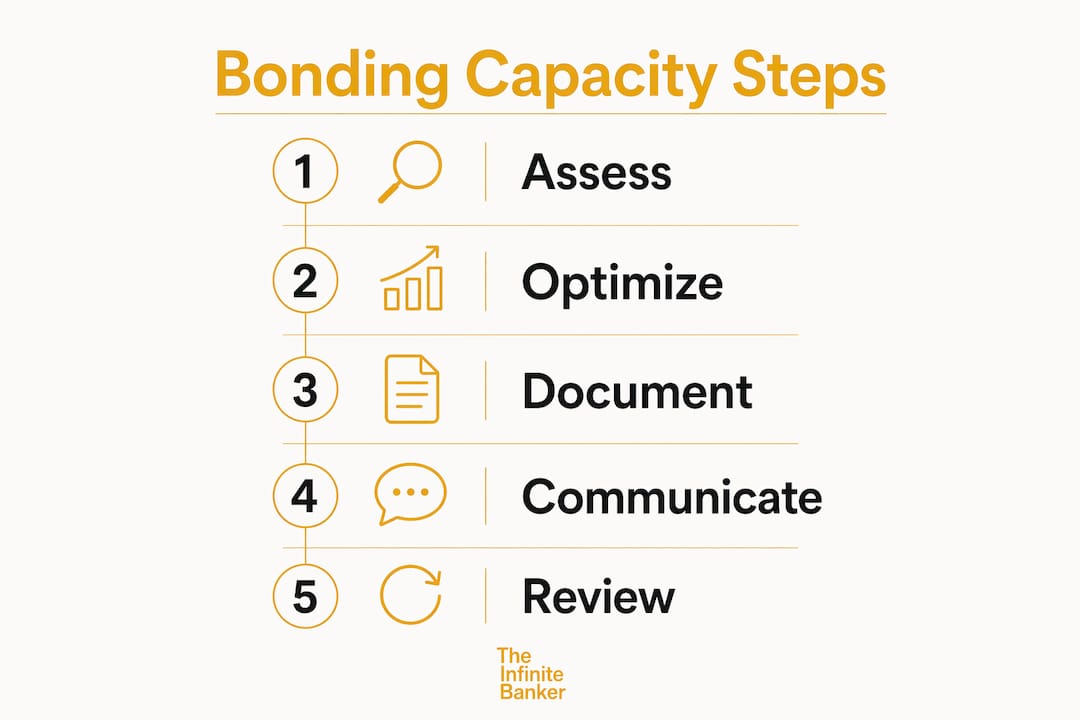
What actions improve bonding capacity?
Improving bonding capacity requires a coordinated set of financial and operational moves, not a single fix. Sureties underwrite based on financial drivers rather than revenue growth, so the actions that matter most target the balance sheet directly.
Improve working capital. Reduce current liabilities, collect receivables faster, and avoid drawing down cash reserves for non-project expenses. Working capital must reliably cover timing gaps in project expenses, which directly affects bonding capacity calculations.
Retain earnings. Distribute only what the business does not need. Every dollar retained grows net worth and equity, which expands the underwriting base.
Maintain accurate WIP schedules. Accurate work-in-progress documentation greatly impacts bonding capacity because sureties adjust aggregate capacity based on cost-to-complete of active jobs. Incomplete or stale WIP can silently reduce available bonding room.
Manage debt carefully. Equipment financing and lines of credit increase current liabilities. Time major purchases to avoid compressing working capital at fiscal year-end.
Build a track record. Complete bonded projects on time and within budget. Each successful completion adds to the credible history underwriters want to see before raising limits.
Upgrade financial statement quality. Move from compiled to reviewed, then to audited financials as your bonding program grows. Higher limits typically require reviewed or audited financials.
Communicate proactively with your surety agent. Submit updated financials, WIP reports, and project updates on a regular schedule. Transparency builds trust faster than any single financial metric.
Support your bank line of credit. A confirmed credit facility signals liquidity discipline and gives underwriters additional comfort about your ability to fund project cash flow gaps.
Pro Tip: Treat your WIP schedule as a living document, not a year-end exercise. Sureties that receive quarterly WIP updates tend to respond faster and more favorably when you request a capacity increase.
How long does it take to build bonding capacity?
Building bonding capacity is a staged process measured in months and years, not weeks. Initial bonding programs can be established in 2–4 weeks with proper documentation. Reaching capacity of $5 million or more may take 2–3 years of successful bonded projects. That timeline reflects the multi-year discipline required to build a track record that underwriters trust.
The practical implications of that timeline include:
Sequence your bids carefully. Pursue projects sized just below your current single-project limit before pushing for larger work. Each completed project strengthens the case for a higher limit.
Plan fiscal year-end positioning. Your balance sheet on the last day of your fiscal year is the primary snapshot underwriters use. Manage working capital and debt with that date in mind.
Monitor profitability consistently. Underwriters watch for consistent profit margins across multiple periods. One strong year followed by a loss raises more concern than steady modest margins.
Avoid claims. A single bond claim can freeze capacity increases for years. Claims history is one of the first things an underwriter checks.
Bonding capacity is not fixed and shifts with financial health, successful project completions, and consistent underwriting dialogue. Regular financial updates and communication build trust and allow capacity growth over time. Joint ventures offer an alternative path for contractors who need to pursue a project beyond their individual limits. Joint ventures can combine bonding capacity proportionally, enabling pursuit of larger projects, though each party remains liable for its share and the surety evaluates combined capacity and risks.
Common pitfalls in bonding capacity strategies
The most costly mistake contractors make is treating bonding capacity as a revenue problem. Bonding capacity is more a balance-sheet and liquidity issue than a revenue problem. Sureties grade contractors on working capital, net worth, and cash flow rather than sales volume. A contractor with $20 million in revenue but thin working capital will hit a bonding ceiling that a $5 million contractor with strong equity may not face.
Other frequent errors include:
Ignoring WIP accuracy. Stale or incomplete WIP reports reduce aggregate capacity without any warning. Sureties base available room on cost-to-complete, so an outdated schedule understates your remaining exposure and distorts the calculation.
Over-leveraging for equipment. Equipment purchases financed with short-term debt compress working capital at exactly the moment underwriters measure it. Time major purchases after your fiscal year-end snapshot.
Neglecting track record development. Contractors who skip smaller bonded projects in favor of chasing large contracts have no documented history to support a capacity increase request.
Waiting to communicate bad news. A project running over budget or behind schedule will surface in your WIP report. Telling your surety agent first, with a recovery plan, preserves trust. Silence does not.
Misreading the multiplier. The 10–20x working capital multiplier is a starting point, not a ceiling. Underwriters adjust it based on statement quality, claims history, and management depth. Assuming the maximum multiplier without earning it leads to rejected bond requests.
A long-term multi-year growth plan with regular surety communication is more effective at raising bonding capacity than transactional requests. Contractors who treat every bond request as a one-time transaction miss the compounding benefit of a documented, consistent financial story.
Key Takeaways
A bonding capacity financial strategy succeeds through balance-sheet discipline, accurate WIP reporting, and consistent surety communication built over multiple years.
Point | Details |
Bonding capacity is balance-sheet driven | Sureties grade working capital, net worth, and cash flow, not revenue volume. |
The 10–20x working capital multiplier sets limits | $250,000 in adjusted working capital may support up to $2.5 million in bonding capacity. |
WIP accuracy directly affects aggregate room | Stale or incomplete WIP schedules can silently reduce available bonding capacity. |
Financial statement quality raises limits | Upgrading from compiled to reviewed or audited financials increases surety confidence and capacity thresholds. |
Capacity growth takes 2–3 years of track record | Initial programs start in weeks; reaching $5 million or more requires multi-year discipline and successful project completions. |
Why financial discipline matters more than deal size
I have worked with entrepreneurs and business owners who assume that winning more contracts will automatically raise their bonding capacity. That assumption is wrong, and it is expensive when it fails at the bid stage. The contractors who build real bonding capacity treat their balance sheet as the product. They retain earnings when it is uncomfortable, they upgrade their financial statements before they need to, and they call their surety agent with updates rather than waiting for the annual review.
The sequencing insight from effective bonding capacity growth is the one most professionals miss: bid smaller, complete cleanly, and document everything. That pattern compounds. A contractor who builds three years of clean bonded project history with reviewed financials and consistent WIP reporting will find capacity increases come with far less friction than one who chases a single large project without the foundation to support it.
Bonding capacity is a long-term business asset. Treat it like one. The financial habits that raise your bonding limit are the same habits that make your business more resilient across every other financing decision you face.
— Jib Hunt
How The Infinite Banker supports your financial foundation
Liquidity and working capital are the two metrics that move bonding capacity most directly. Entrepreneurs who want to strengthen both without relying entirely on bank lines of credit have found that properly structured dividend-paying whole life insurance policies can serve as a complementary financial tool. The cash value inside a whole life policy may be accessed through policy loans, which accrue interest and reduce cash value and death benefit if unpaid. Policies can also lapse if not properly funded. Dividends are not guaranteed. With those realities understood, The Infinite Banker works with entrepreneurs and business owners to implement whole life strategies designed for capital efficiency and long-term flexibility.

For professionals exploring how whole life fits business financing, The Infinite Banker’s entrepreneur-focused resources explain the mechanics, the tradeoffs, and the practical applications in plain language.
FAQ
What is bonding capacity in simple terms?
Bonding capacity is the maximum dollar value of surety-bonded work a contractor can hold at one time, set by a surety based on financial strength and project history. It operates as both a single-project limit and an aggregate limit across all active bonded work.
What financial metrics affect bonding capacity most?
Adjusted working capital, net worth, and debt-to-equity ratio are the primary metrics sureties use to set bonding limits. Sureties typically size bonding programs at 10–20 times a contractor’s adjusted working capital.
How long does it take to increase bonding capacity?
Initial bonding programs can be established in 2–4 weeks with proper documentation, but reaching capacity of $5 million or more typically requires 2–3 years of successful bonded projects and consistent financial improvement.
Why does WIP reporting matter for bonding capacity?
Sureties calculate aggregate capacity based on the cost-to-complete of active jobs, not original contract values. Incomplete or outdated WIP schedules can silently reduce available bonding room without any formal notification.
Can joint ventures increase bonding capacity?
Joint ventures can combine bonding capacity proportionally, allowing contractors to pursue projects beyond their individual limits. Each party remains liable for its share, and the surety evaluates the combined financial strength and risk of both parties.
This post is educational only and not financial, tax, or legal advice. Consult qualified professionals before acting.
Recommended
Comments